

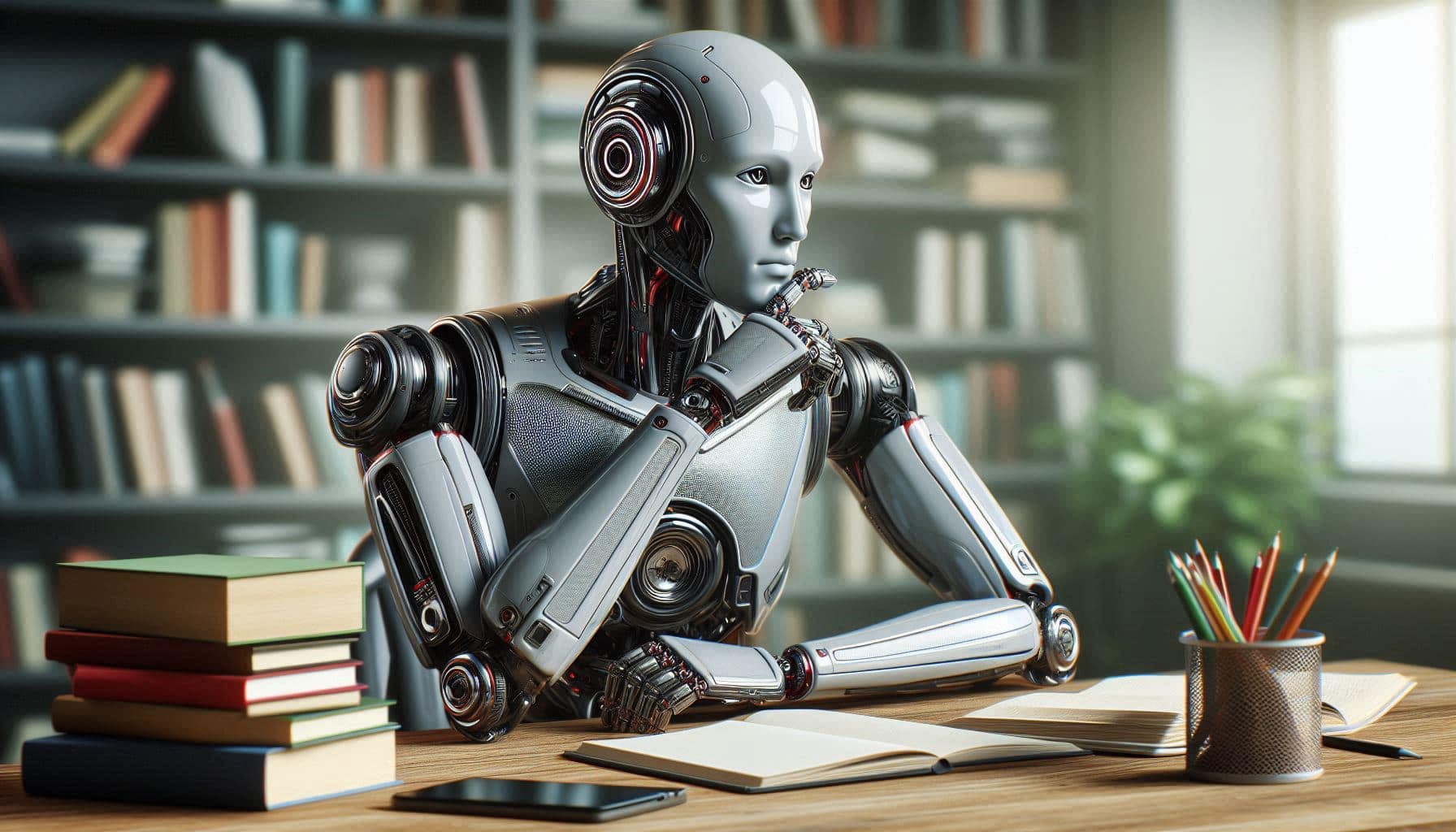

Humans dream. In the quiet theater of our minds, we replay memories, rehearse future conversations, and navigate bizarre, impossible scenarios. This nocturnal process isn’t just random noise; it’s crucial for how we learn, consolidate memories, and adapt to the world. Now, imagine giving this ability to a robot. What if an AI could spend its “downtime” running through a million possible futures, practicing a complex task in a virtual world of its own creation before ever attempting it in reality? This is not science fiction. It’s a revolutionary approach in artificial intelligence that is teaching robots to “dream”—and it’s poised to change everything we thought we knew about machine learning.
Table Of Content
Why Do Robots Need to Dream? The Simulation Bottleneck
One of the biggest hurdles in robotics is the sheer inefficiency of learning in the real world. For a robot to learn a simple task like picking up a cup, it might require thousands of attempts. This process is slow, expensive, and often destructive—imagine a multi-million-dollar industrial robot learning to walk by falling down ten thousand times. This “physical trial-and-error” method is a major bottleneck holding back more advanced and adaptable robotic systems.
This is where the concept of robotic “dreaming” comes in. Instead of relying solely on clumsy, real-world experience, what if a robot could generate its own data? The dream, for an AI, is an internally generated, accelerated simulation of reality. In the time it would take to perform one physical action, a robot can “dream” of ten thousand variations, learning from each simulated success and failure. This allows it to compress weeks of physical learning into a few hours of simulated practice.
Inside the Digital Dreamscape: How It Works
So, what does a robot’s dream look like? It’s not a narrative of electric sheep. Rather, it’s a dynamic, predictive model of the world, built from data and governed by the laws of physics as the robot understands them. The technology hinges on two key concepts.
First, the robot creates a “World Model.” From its limited real-world experience, the AI learns a compressed, internal representation of how the world works. It’s not a perfect, high-fidelity replica, but a simplified model of cause and effect (e.g., “If I apply X amount of force to this object, it will move Y distance”). This learned model becomes the robot’s personal sandbox, its dreamscape.
Second, it uses Reinforcement Learning within this dreamscape. Once the robot is “asleep” (i.e., offline and not interacting with the real world), it can use its world model to practice tasks relentlessly. A robot arm can simulate picking up a block a million times, exploring every possible angle, grip strength, and trajectory. For every successful virtual attempt, it receives a digital “reward”; for every failure, it learns a boundary. This process, explored extensively by researchers at Google AI, allows the robot to rapidly develop a sophisticated strategy. When it “wakes up,” it’s no longer a novice but an expert, ready to apply its dream-honed skills to the physical world with far greater success.
A surprising fact: The “dreams” of these AIs can look incredibly surreal to human eyes. Because the robot is only simulating the variables relevant to its task, its dream might be a distorted, low-resolution version of reality. It might ignore color and texture, focusing only on mass, friction, and momentum. The result can look like a glitchy, physics-based Salvador Dalí painting—visually bizarre to us, but perfectly functional and efficient for the robot’s learning process.
The Waking World: From Dreams to Reality
This ability to learn from self-generated dreams has profound, real-world consequences. It dramatically accelerates the training process and creates far more robust and adaptable machines.
- Manufacturing and Logistics: A warehouse robot that encounters a new, oddly shaped package doesn’t need to wait for a human to program it. It can “nap” for a few minutes, dream up thousands of ways to grip the new object, and then execute the optimal solution.
- Autonomous Vehicles: Self-driving cars already use massive simulations to learn. But with world models, a car’s AI could “dream” of millions of rare and dangerous edge cases it has never personally encountered—a child chasing a ball into the street, a sudden blizzard—and practice the correct response, making it safer and more reliable.
- Medicine: A surgical robot could practice a complex and delicate procedure thousands of times in a hyper-realistic simulation of a patient’s unique anatomy before ever making the first incision.
Another little-known fact: This technique helps robots adapt to unexpected changes in the real world. If a robot trained to sort blue blocks suddenly encounters a heavier red block, its first physical attempt might fail. It can then retreat into its world model, update its understanding of physics based on that failure, “dream” about the properties of red blocks, and quickly formulate a new, successful strategy.
Furthermore, scientists have found that these “dreaming” periods can help prevent a common AI problem called “catastrophic forgetting,” where learning a new skill causes an AI to erase its knowledge of a previous one. Just like sleep helps humans consolidate memories, dreaming helps the AI integrate new information with its existing knowledge base.
Robotic dreaming is transforming AI from a passive learner, dependent on human-provided data, into an imaginative agent capable of predicting and preparing for a future it hasn’t yet seen.
As these machines learn to dream up their own solutions and explore an infinite space of possibilities within their own minds, we are forced to ask a profound question: what happens when their dreams become more complex and insightful than our own?
References
- Hafner, D., Lillicrap, T., Ba, J., & Norouzi, M. (2019). Dream to Control: Learning Behaviors by Latent Imagination. arXiv preprint arXiv:1912.01603.
- Google AI Blog. (2018, May 18). An Introduction to “World Models”.
- Note: A blog post explaining the concept of world models and their use in training AI agents.
- Link: https://ai.googleblog.com/2018/05/an-introduction-to-world-models.html
- Kahn, G., & Abbeel, P. (2017). PLATO: Policy Learning using Adaptive Trajectory Optimization. arXiv preprint arXiv:1703.00450.
- Note: A research paper on using simulation to help robots adapt to new scenarios.
- Link: https://arxiv.org/abs/1703.00450
- Simonite, T. (2018, October 11). To Make a Robot That Can Learn, Let It Play. Wired.
- Note: An article discussing how simulated play and trial-and-error are key to robotic learning.
- Link: https://www.wired.com/story/to-make-a-robot-that-can-learn-let-it-play/