




The image is iconic: a machine hums, flashes, and vanishes, whisking its occupant to the age of dinosaurs or a gleaming, chrome future. From H.G. Wells to Back to the Future, time travel has been a cornerstone of science fiction. But what does actual science say? The surprising truth is that our most profound scientific theory, Albert Einstein’s relativity, doesn’t slam the door on time travel. In fact, its mind-bending equations describing how gravity warps space and time are precisely what cracked the door open. Is a journey through time a fantastical dream, or is it a bizarre possibility hidden within the laws that govern our cosmos?
Table Of Content
The Easy Part: A One-Way Ticket to the Future 🚀
Believe it or not, traveling into the future is not only theoretically possible, but it’s a proven fact of our universe. It happens all the time, just in incredibly small amounts. The phenomenon is called time dilation, a core prediction of Einstein’s theories of relativity, and it comes in two flavors.
First, time is relative to speed. Einstein’s Special Relativity dictates that the faster you move through space, the slower you move through time. Imagine a pair of twins. One stays on Earth while the other blasts off in a spaceship that travels at 99.9% the speed of light. For the astronaut twin, time would pass much more slowly. When they return to Earth after what felt like five years to them, they would find that 50 years had passed on Earth. Their twin would be an old-timer, while they would have effectively leaped half a century into the future. This isn’t just a thought experiment; the clocks on fast-moving GPS satellites have to be constantly adjusted to account for this effect.
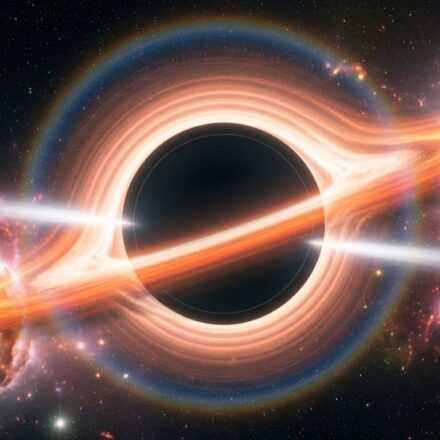
Second, time is relative to gravity. General Relativity shows that strong gravity warps spacetime, causing time itself to slow down. Time runs ever so slightly slower for someone at sea level than for someone on a mountaintop. This effect would become extreme near a supermassive object like a black hole. An astronaut who orbited a black hole for a few hours would return to their ship far from the gravitational well to find that years, or even centuries, had passed. The future isn’t a destination to be reached; it’s a state you can arrive at by slowing your own personal clock down.
A surprising fact: You are a time traveler at this very moment. Because your feet are closer to Earth’s center of gravity than your head is, time is passing infinitesimally slower for your feet than for your head. The difference is absurdly small, but it has been measured with hyper-accurate atomic clocks.
The Hard Part: Finding a Path to the Past
Traveling to the future is an engineering problem; traveling to the past is a physics problem. It requires a way to loop or bend spacetime back on itself, and while the equations allow for it, they demand some truly exotic cosmic architecture.
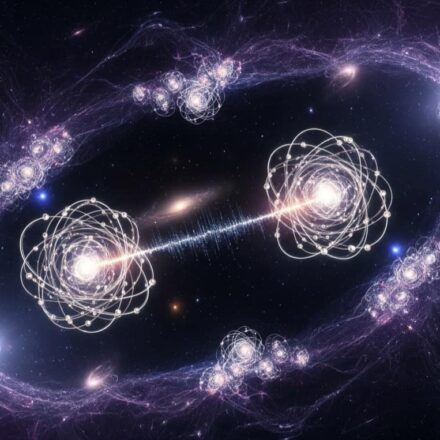
The most famous theoretical pathway is a wormhole, or what physicists call an Einstein-Rosen bridge. General Relativity permits the existence of these tunnels through spacetime, potentially connecting two distant points in the universe like a shortcut. Nobel laureate Kip Thorne and other physicists have shown that if you could create a stable wormhole, you could turn it into a time machine. By taking one “mouth” of the wormhole on a round trip at near-light speed, time dilation would cause it to age less than the stationary mouth. You could then enter the “younger” mouth and exit the “older” one, arriving at a point in spacetime before you left.
The colossal catch? Keeping a wormhole open would require a substance known as exotic matter—a hypothetical material with negative mass and negative pressure, which would exert gravitational repulsion. We have never observed such matter, and it may not exist.
The Paradoxical Problem: You Can’t Un-ring a Bell 🔔
Even if you could build a time machine, you’d immediately run into a logical minefield: paradoxes.
The most famous is the Grandfather Paradox: What if you travel to the past and stop your own grandparents from ever meeting? If they never meet, you are never born. If you are never born, you could never have gone back in time to stop them. A contradiction is created, and the universe, it seems, should not allow it. So how does physics handle this? There are two main get-out clauses.
The Novikov Self-Consistency Principle: Russian physicist Igor Novikov proposed that the laws of physics are self-consistent and will simply forbid any action that creates a paradox. You can travel to the past, but you cannot change it. The universe ensures your “free will” is constrained. You might try to shoot your grandfather, but your gun will jam, you’ll slip on a banana peel, or a bird will fly in the way. Your actions would become part of the history that already happened, not an alteration of it.
The Many-Worlds Interpretation: This idea, born from quantum mechanics, suggests that any paradox-creating action simply causes the timeline to split. If you prevent your grandparents from meeting, you don’t erase yourself from existence; you simply create a new, parallel universe where you are never born. Your original timeline remains completely unaffected.
Another surprising fact: To test for the existence of time travelers from the future, the late Stephen Hawking threw a party. In 2009, he arranged for champagne and balloons but only sent out the invitations—complete with the precise time and coordinates—after the party was over. His logic was that only someone who could travel back in time would be able to see the invitation and attend. Nobody showed up.
The laws of our universe seem to permit a one-way trip to the future, but a journey to the past remains locked behind the need for impossible materials and the universe’s own logical safeguards.
The equations seem to allow for pathways to the past, even if they guard them with seemingly impossible physics. Does this mean time travel is a forbidden game, or are we simply too primitive to understand the rules?
References
- Einstein, A. (1916). Relativity: The Special and the General Theory. Methuen & Co Ltd.
- Note: The original source material outlining the principles of time dilation. Available in numerous modern reprints.
- Thorne, K. S. (1994). Black Holes and Time Warps: Einstein’s Outrageous Legacy. W. W. Norton & Company.
- Note: A book by a Nobel laureate and world expert on wormholes, explaining the concepts for a popular audience.
- NASA. (n.d.). GPS, Relativity, and You. NASA Space Place.
- Novikov, I. D. (1998). The River of Time. Cambridge University Press.
- Note: A book by the physicist who proposed the self-consistency principle.
- Dvorsky, G. (2012, July 5). Stephen Hawking’s Time Travel Party. Gizmodo.