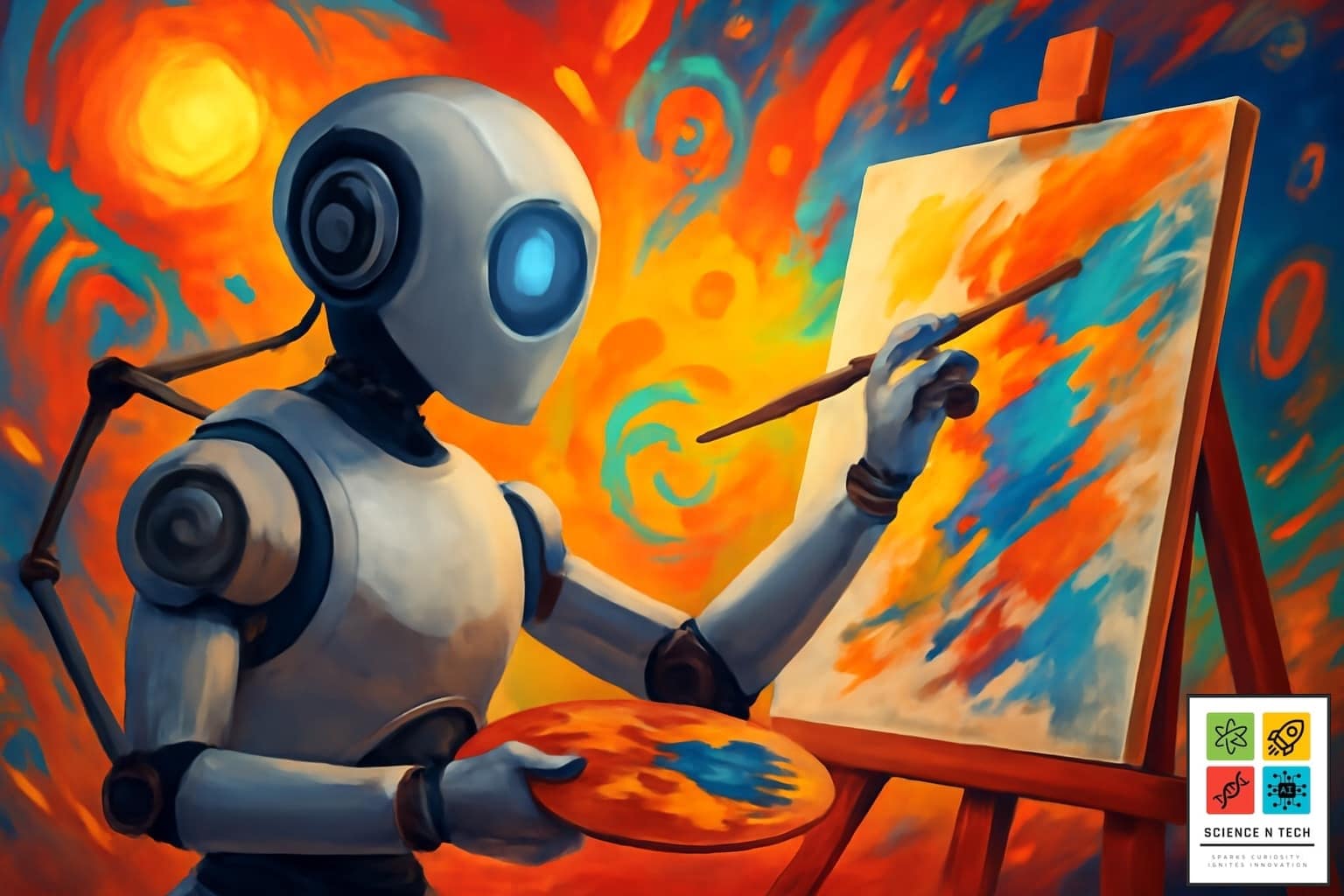

Behold a work of art: a breathtaking, photorealistic image of an astronaut riding a horse on the surface of Mars, the style reminiscent of a Dutch Master painting. The detail is immaculate, the lighting is sublime, the concept is wildly original. It must be the work of a visionary human artist. But it isn’t. It was generated in under a minute by an artificial intelligence from a simple line of text. This explosion of AI art from generators like Midjourney, DALL-E, and Stable Diffusion has taken the world by storm, producing images of astonishing beauty and absurdity. It raises a profound question: how can a machine, a collection of algorithms and data, create something so genuinely artistic? The answer lies in a revolutionary process that has, in essence, allowed AI to teach itself how to dream.
Table Of Content
Learning the Language of Art: From Pixels to Concepts
An AI artist’s journey begins just like a human’s: with study. But instead of visiting museums, it’s fed a colossal dataset, often containing billions of images and their corresponding text descriptions scraped from the internet. This process, powered by models like OpenAI’s CLIP (Contrastive Language-Image Pre-training), is the AI’s art school.
During this phase, the AI learns to build a bridge between words and images. It doesn’t just learn that a specific jumble of pixels is a “cat.” It learns the abstract concepts associated with the word “cat” from countless examples. It learns what “fluffy” looks like, what “sitting” looks like, what “sad” looks like. It learns the difference between a photograph, a pencil sketch, and an oil painting. It deconstructs style, associating phrases like “in the style of Vincent van Gogh” with swirling brushstrokes and vibrant colors, or “cinematic lighting” with high-contrast shadows.
This creates a high-dimensional mathematical map in the AI’s “mind” called the latent space. In this space, similar concepts cluster together. “Dog” is near “puppy,” which is near “wolf.” More abstractly, “King – Man + Woman” mathematically points to the concept of “Queen.” It’s by learning these rich, contextual relationships that the AI builds the vocabulary it needs to understand our creative requests.
The Creative Dream: How Diffusion Models “Paint”
The real magic happens in the image generation process, which for most modern AI artists is a technique called diffusion. It’s a beautifully counter-intuitive method of creating something from nothing.
Here’s an analogy:
The Corruption: Imagine you start with a crystal-clear photograph. The AI is first trained by taking this image and gradually adding layers of digital “noise”—random static—step by step, until the original photograph is completely lost in a meaningless gray fuzz.
Learning to Reverse: The crucial part of the training is that the AI is forced to learn how to reverse this process. It learns how to look at a noisy image and predict what the slightly-less-noisy version of it should be. It repeats this over and over, learning to pull a coherent signal out of the static.
The Creation: Now, when you give the AI a prompt like, “A photorealistic astronaut riding a horse on Mars,” the creative process begins. The AI starts with a canvas of pure, random noise. Then, guided by the “latent space” map it built earlier, it begins the denoising process. At each step, it asks itself, “How can I change this noise so it looks a little more like ‘horse’ and a little more like ‘astronaut’ and a little more like ‘Mars’?”
It slowly carves the image out of static, refining the chaos into form, much like a sculptor carves a statue from a block of marble. It is not copying or stitching images together; it is generating a brand new image from pure potential, steered by the meaning of your words. It is, in a very real sense, a controlled dream.
A surprising fact: AI art has already fooled the experts and triumphed in competitions. In 2022, a stunningly detailed piece created with Midjourney won first place in the digital arts category at the Colorado State Fair, sparking a massive international debate about whether an AI can be an artist and what this means for human creativity.
More Than a Photocopier: The Question of Creativity
Is this real creativity, or just sophisticated mimicry? Because the AI starts from random noise and generates entirely new pixel arrangements, it is not “collaging” old images. It can create compositions and subjects that have never existed in its training data—like “a sentient armchair giving a TED talk.” This ability to synthesize novel concepts is a form of emergent creativity.
However, the ethics are complex and fiercely debated. These models are trained on the work of millions of human artists, often without their consent, leading to accusations that the AI is merely a tool for style plagiarism. It raises fundamental questions: Can art exist without intent, emotion, and lived experience? Or is the human prompter the true artist, using the AI as an incredibly advanced paintbrush?
What is clear is that these neural networks are not just tools; they are collaborators. They are mirrors reflecting the entirety of our visual culture back at us, but through a strange, alien consciousness that can see connections and possibilities we never could.
We’ve taught machines to see the world and all the art it contains. Now, they are showing us new worlds of their own creation. As the line between human and machine creativity continues to blur, what does it mean to be an artist, and what new forms of expression will we discover together?
References
- Radford, A., Kim, J. W., Hallacy, C., et al. (2021). Learning Transferable Visual Models From Natural Language Supervision. Proceedings of the 38th International Conference on Machine Learning.
- Note: This is the paper that introduced the CLIP model, foundational for text-to-image generation.
- Link: https://proceedings.mlr.press/v139/radford21a.html
- Rombach, R., Blattmann, A., Lorenz, D., et al. (2022). High-Resolution Image Synthesis with Latent Diffusion Models. Proceedings of the IEEE/CVF Conference on Computer Vision and Pattern Recognition.
- Note: This is the paper that introduced Stable Diffusion.
- Link: https://arxiv.org/abs/2112.10752
- Roose, K. (2022, September 2). An A.I.-Generated Picture Won an Art Prize. Artists Aren’t Happy. The New York Times.
- Vincent, J. (2022, August 15). The scary truth about AI art is that it’s getting better. The Verge.