


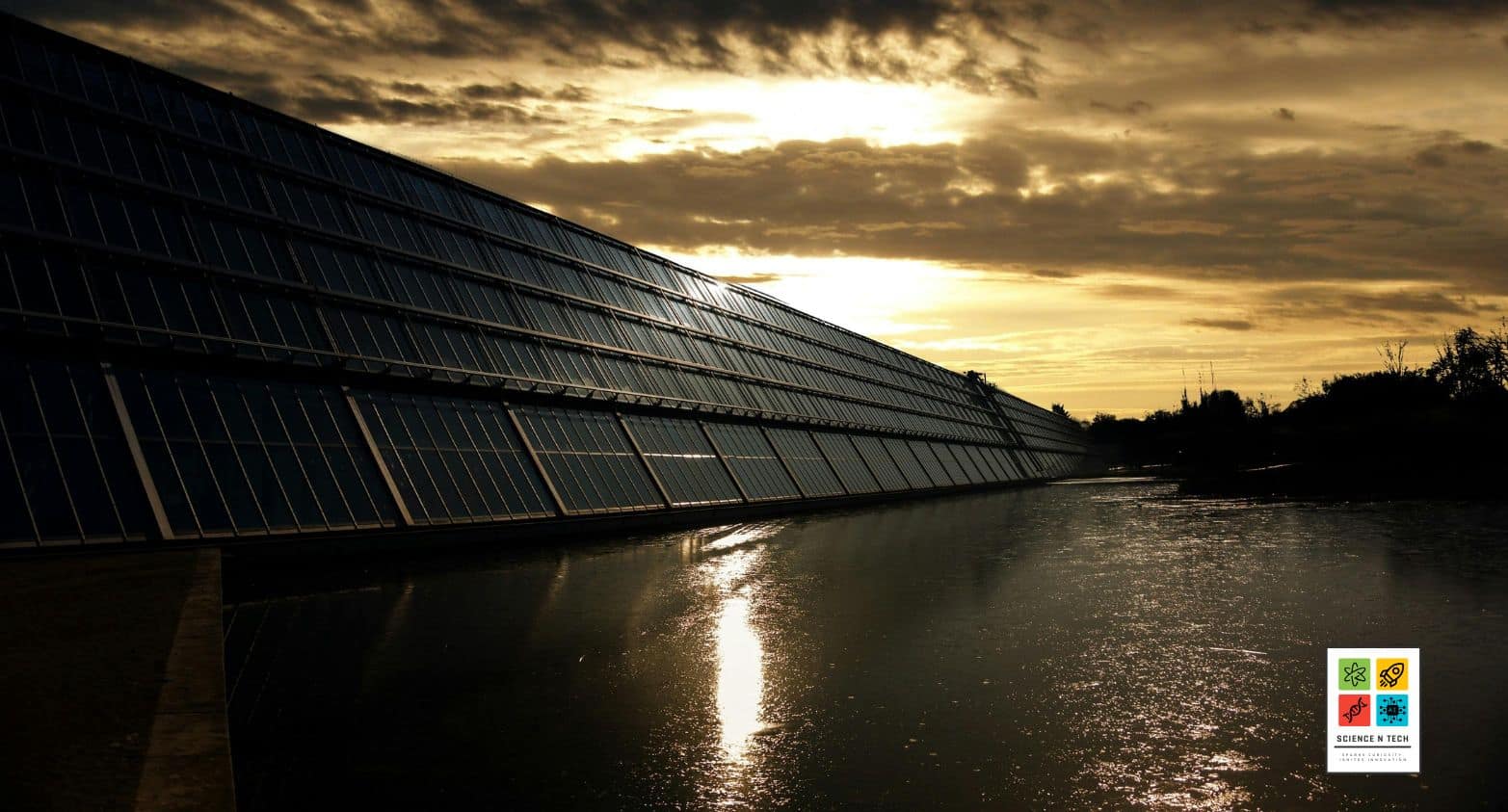

The greatest promise of solar power has always been shadowed by its most fundamental limitation: the sun eventually sets. For clean energy to power our world 24/7, we’ve relied on massive, expensive batteries to store daytime energy for overnight use. But what if that core limitation could be broken? What if a device, similar to a solar panel, could continue generating electricity long after sunset, using the cold, dark sky itself as a power source? In a mind-bending scientific breakthrough, researchers have done just that, developing a prototype “anti-solar panel” that works in reverse, harvesting energy from the darkness.
Table Of Content
The Problem of the Dark: How Solar Power Works
To understand this new technology, we first have to remember how a conventional solar panel works. A standard photovoltaic (PV) cell is made of a semiconductor material that absorbs photons—particles of light—from the hot sun. When these photons strike the cell, they knock electrons loose, creating a flow of electricity. The panel is a heat engine that takes advantage of a massive temperature difference: it’s a relatively cool object being hit by light from the incredibly hot sun (around 6,000°C). When the sun goes down, the source of high-energy photons vanishes, and power generation stops.
Flipping the Script: The Physics of Radiative Cooling
The new night-time device works by brilliantly flipping this entire concept on its head. It doesn’t rely on incoming light but on outgoing heat, using a principle called thermoradiative photovoltaics.
Here’s the core idea: any object that is warmer than its surroundings will radiate energy away in the form of heat (infrared radiation). After a full day of sunshine, the Earth and the objects on it are warm. At night, they begin to radiate this heat back out towards the vast coldness of deep space. The night sky isn’t just dark; it’s an incredible heat sink, with an effective temperature of just 3 Kelvin (-270°C).
The night-time solar panel is engineered to exploit this temperature difference. It’s essentially a specialized solar cell pointed up at the cold night sky. The device itself, sitting on a rooftop, is at the ambient temperature of the surrounding air, making it significantly warmer than the deep space it’s facing. This temperature difference creates an opportunity to generate power.
Instead of absorbing photons, the device’s surface emits its own heat (infrared photons) outwards. As this heat flows from the warmer panel to the colder sky, a specially designed semiconductor diode within the device is able to capture a small amount of energy from this outward flow of radiation, generating a voltage and a current. In simple terms, while a regular solar panel generates power from light hitting it, this device generates power from heat leaving it.
As Shanhui Fan, a professor at Stanford University and a pioneer of this research, puts it, “What we have done is the same principle as a solar cell, but we are looking at it from the opposite direction.”
The Reality Check: Power Output and Future Potential
So, could these night-time panels power your home overnight? Not yet. The reality is that the amount of energy being radiated away from the Earth is far less than the torrent of energy coming in from the sun. The current prototypes generate a very small amount of power—about 50 milliwatts per square meter. For comparison, a typical daytime solar panel can generate about 200 watts per square meter, thousands of times more.
However, even at this low output, the technology has incredible potential for specific applications:
Off-Grid and Remote Lighting: It could power low-wattage LED lights, sensors, or monitoring equipment in remote locations where changing batteries is impractical.
Complementing Solar Farms: By providing a continuous, low-level charge overnight, these devices could reduce the amount of energy that needs to be drawn from expensive battery storage, extending battery life and lowering overall costs for a 24-hour renewable system.
Researchers are now focused on improving the materials and design to boost the power output. While they may never match the output of daytime solar, even a modest improvement could make them a vital component in our future energy grid.
A surprising fact: This technology is conceptually similar to how night-vision goggles work. Both devices are designed to detect the infrared radiation (heat) that objects emit. The key difference is that instead of converting that signal into a visual image, the night-time panel converts the flow of that energy into electricity.
By literally thinking in reverse, scientists have opened a new frontier in renewable energy. They’ve shown that we aren’t just limited to harvesting energy coming to Earth; we can also harvest the energy that our planet radiates back into the cosmos. What other “impossible” energy sources are hiding in plain sight, waiting for us to simply look at the problem from a different angle?
References
- Raman, A. P., Anoma, M., Zhu, L., Rephaeli, E., & Fan, S. (2014). Passive radiative cooling below ambient air temperature under direct sunlight. Nature, 515(7528), 540-544.
- Deppe, T., & Munday, J. N. (2020). Nighttime Photovoltaic Cells: Electrical Power Generation by Optically Coupling with Deep Space. ACS Photonics, 7(1), 1-8.
- Note: A key paper from UC Davis outlining the “anti-solar panel” concept.
- Link: https://pubs.acs.org/doi/10.1021/acsphotonics.9b00679
- Carnegie, D. (2022, April 5). Scientists developed a solar panel that works in the dark. Euronews.
- Stanford University. (2019, November 5). Stanford engineers devise a way to generate electricity from the cold of the night. Stanford News.