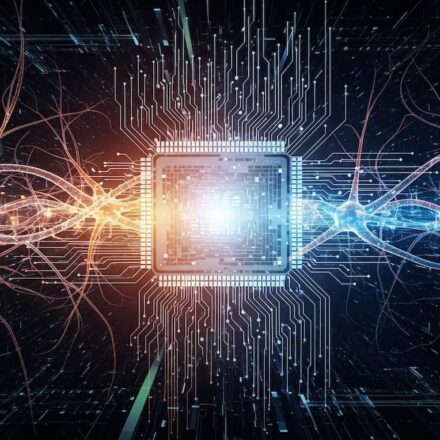




For the past seventy years, our world has been built by classical computers. From your smartphone to the most powerful supercomputers, they all operate on the same fundamental principle: bits of information that are either a 0 or a 1. This binary logic has given us the modern world, but it has its limits. There exists a class of problems so complex—designing life-saving drugs, creating new materials at the atomic level, or breaking the codes that protect global finance—that our best supercomputers would take longer than the age of the universe to solve them. To crack these “unsolvable” problems, we need a new kind of machine. We need a quantum computer. This isn’t just a faster computer; it’s a new paradigm of computing, one that operates on the bizarre and powerful rules of the quantum realm.
Table Of Content
The Classical Bit vs. The Quantum Qubit
The fundamental difference between a classical computer and a quantum computer comes down to its basic unit of information. A classical computer uses a bit, which is like a light switch: it can be in one of two definite states, either ON (1) or OFF (0).
A quantum computer uses a qubit. A qubit is a quantum system—like an electron or a photon—that harnesses two strange principles of quantum mechanics:
Superposition: Unlike a bit, a qubit doesn’t have to be just a 0 or a 1. It can exist in a combination of both states simultaneously. Think of a spinning coin. While it’s in the air, it’s neither heads nor tails; it’s a fuzzy blend of both possibilities. Only when it lands (when we measure it) does it collapse into a definite state. This ability to exist in multiple states at once allows quantum computers to process a vast number of possibilities simultaneously.
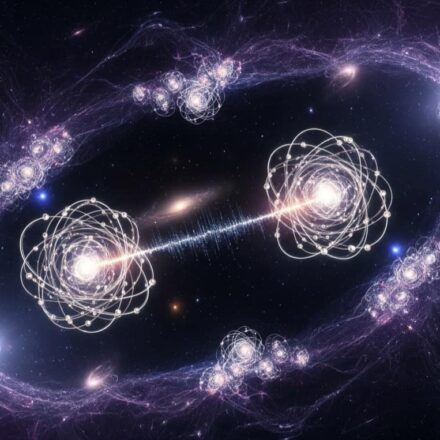
Entanglement: This is what Einstein famously called “spooky action at a distance.” Two qubits can become entangled, meaning their fates are intrinsically linked, no matter how far apart they are. If you measure one entangled qubit and find it in the “0” state, you instantly know its partner is in the “1” state, and vice versa. This allows for complex correlations and information processing that is impossible for classical bits, creating a powerful network of interconnected qubits.
Because of these properties, the power of a quantum computer grows exponentially. While two bits can only represent one of four possible combinations (00, 01, 10, or 11) at any one time, two qubits can represent all four combinations at once. For a few hundred qubits, a quantum computer could represent more states than there are atoms in the known universe.
Why Do We Need Them? The Problems They Can Solve
This exponential power isn’t for Browse the internet faster; it’s for tackling specific, monumentally complex calculations.
Drug Discovery and Materials Science: Nature is quantum. The way molecules bond and proteins fold is governed by quantum mechanics. Classical computers struggle to simulate this accurately. A quantum computer could precisely model how a new drug molecule interacts with a virus or design a new catalyst for carbon capture, revolutionizing medicine and green technology.
Cryptography and Security: Many of the encryption algorithms that protect our banking, government secrets, and online data rely on the fact that it’s incredibly difficult for classical computers to factor very large numbers. A sufficiently powerful quantum computer, using Shor’s algorithm, could theoretically break this encryption with ease. This has sparked a race to develop new “quantum-resistant” cryptography.
Complex Optimisation: Many real-world problems involve finding the best solution from a staggering number of possibilities, from optimising shipping routes for a global logistics company to designing better financial models. Quantum computers could explore all possibilities at once to find the optimal solution in a fraction of the time.
The Quantum Race: Where Are We Now?
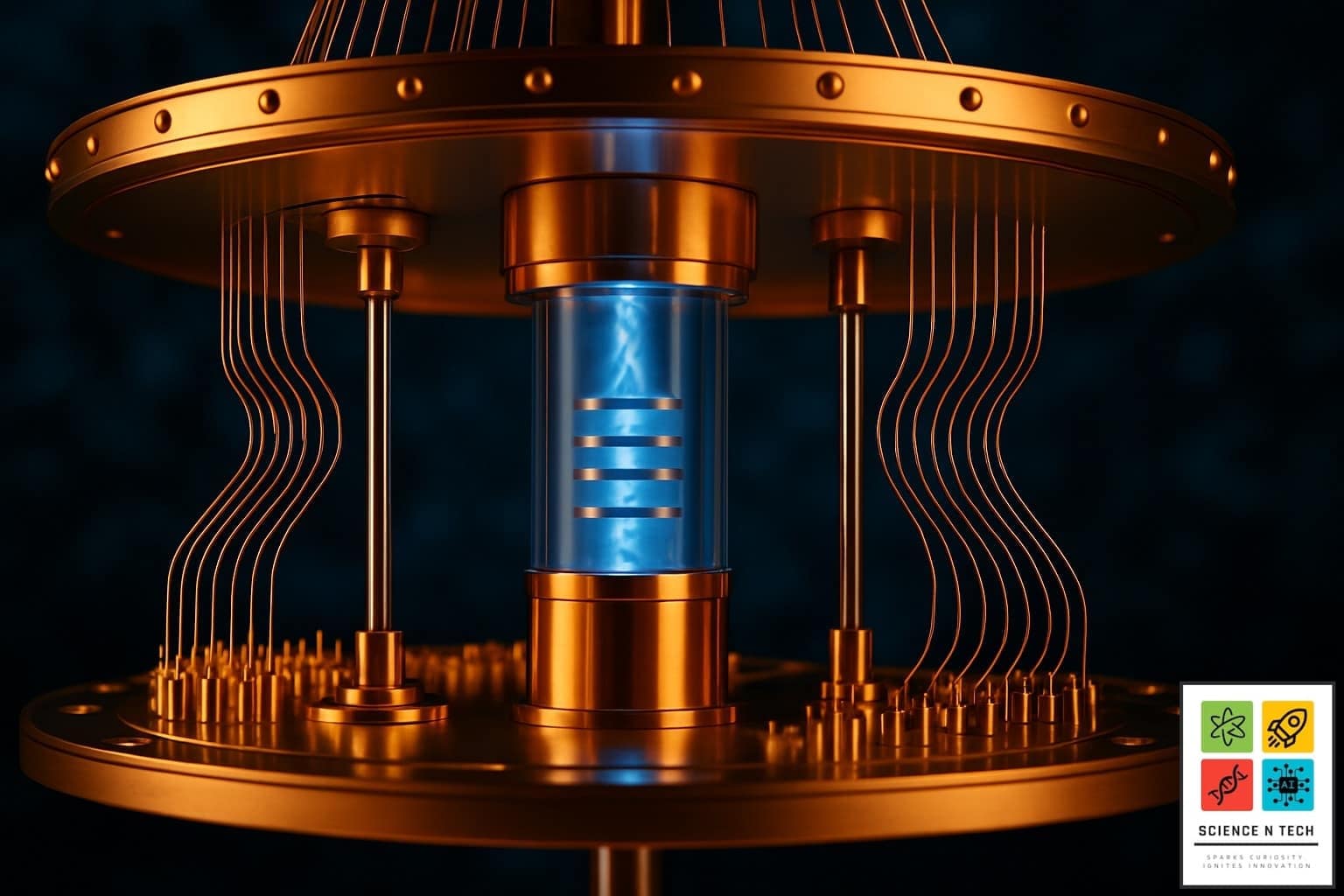
Building and operating a quantum computer is one of the greatest engineering challenges ever undertaken. The main enemy is a phenomenon called decoherence. Qubits are incredibly fragile; the slightest vibration, temperature change, or stray magnetic field can cause them to lose their quantum state and collapse into simple 1s and 0s, destroying the computation. This is why quantum computers, like those being built by Google and IBM, are housed in huge, multi-million-dollar dilution refrigerators, cooled to temperatures colder than deep space and shielded from the outside world.
We are currently in what experts call the “NISQ” (Noisy Intermediate-Scale Quantum) era. Today’s machines have dozens or even hundreds of qubits, but they are still too “noisy” and error-prone to solve major real-world problems. They are essentially powerful, experimental tools for researchers.
Right here in Australia, researchers are at the global forefront of this race. The work being done at the University of New South Wales (UNSW), led by pioneers like Professor Michelle Simmons, on building qubits out of individual atoms in silicon is world-leading and represents a promising path toward stable, large-scale quantum computers.
A surprising fact: The first claim of “quantum supremacy” was made in 2019. Google’s Sycamore processor performed a specific, esoteric calculation in 200 seconds. They estimated it would have taken the world’s most powerful supercomputer, Summit, 10,000 years to do the same task. While its practical use was nil, it was a major “Wright brothers’ first flight” moment for the field.
The quantum revolution won’t happen overnight. But as we learn to build bigger and more stable machines, we are moving steadily towards an era where the “unsolvable” is finally within our reach. The first digital computers changed our world in ways their inventors could barely have imagined. As we learn to harness the strange logic of the quantum realm, what new frontiers will we conquer?
References
- Arute, F., Arya, K., Babbush, R., et al. (2019). Quantum supremacy using a programmable superconducting processor. Nature, 574(7779), 505-510.
- IBM. (n.d.). What is quantum computing?
- Centre of Excellence for Quantum Computation and Communication Technology (CQC²T). (n.d.). Official Website.
- Note: The Australian research centre, headquartered at UNSW, leading silicon-based quantum computing efforts.
- Link: https://www.cqc2t.org/
- Preskill, J. (2018). Quantum Computing in the NISQ era and beyond. Quantum, 2, 79.
- Nielsen, M. A., & Chuang, I. L. (2010). Quantum Computation and Quantum Information: 10th Anniversary Edition. Cambridge University Press.
- Note: The standard textbook and comprehensive reference for the field.