


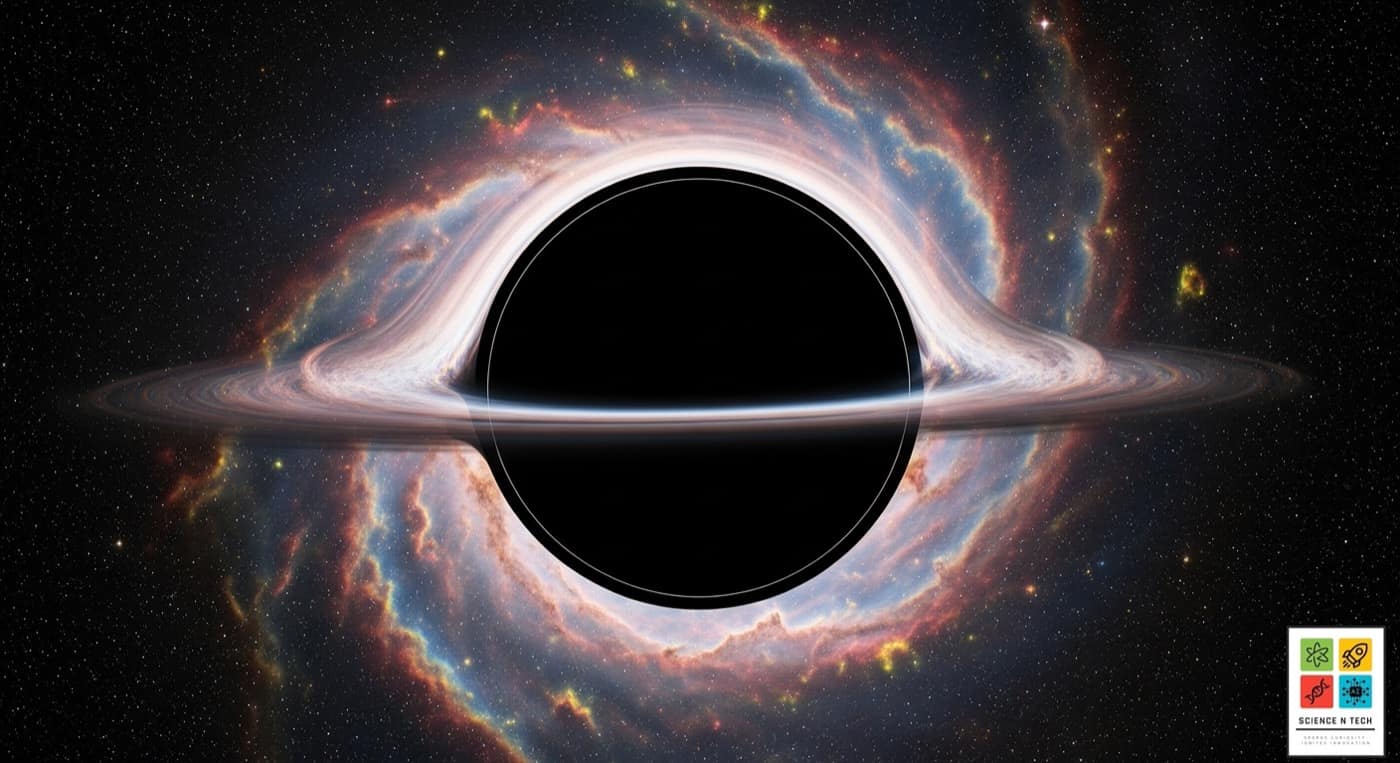

It is the universe’s ultimate prison. A place where gravity is so immense that nothing, not even light, can escape its grasp. A black hole is a one-way door in spacetime, and its edge—the event horizon—is the point of no return. While we can never send a probe inside and expect a message back, the strange and beautiful laws of physics, first charted by Albert Einstein, give us a theoretical roadmap for this journey into the abyss. So, let’s take a theoretical plunge. What really happens when you cross that final frontier and fall into the darkest object in the cosmos?
Table Of Content
The Plunge: Crossing the Event Horizon
The experience of falling into a black hole depends dramatically on where an observer is watching from. To a distant friend watching your journey through a powerful telescope, a bizarre scene unfolds. As you approach the event horizon, they would see your image slow down, seeming to take an eternity to reach the edge. The light from you would become stretched and redder—an effect called gravitational redshift—until you fade into a frozen, dim silhouette, forever plastered on the boundary. From their perspective, you never actually cross.
But for you, the journey is shockingly different. For a giant, supermassive black hole like the one at our galaxy’s center, the event horizon is a remarkably peaceful place. The curvature of spacetime is so gentle at the boundary that you would float across it without any immediate sensation. There’s no wall, no signpost. One moment you could, in theory, escape. The next, you are locked on an irreversible path.
The real terror comes later, in the form of spaghettification. As you plummet deeper, the tidal forces become extreme. The gravitational pull on your feet would be exponentially stronger than the pull on your head, stretching your body on a cosmic rack. You would be elongated into a long, thin stream of atoms, like a strand of spaghetti, before being torn apart completely. For smaller, stellar-mass black holes, this gruesome process happens even before you reach the event horizon.
The Classical View: A Date with the Singularity
According to Einstein’s General Theory of Relativity, which has perfectly described gravity on large scales, all paths inside a black hole lead to one place: the singularity. This is the heart of the black hole, a region where all the matter that has ever fallen into it—entire stars, planets, and gas clouds—is crushed into a point of effectively zero volume and infinite density. It is the end of the road, where the laws of physics as we know them break down.
One of the most mind-bending consequences of relativity occurs inside the event horizon: space and time swap roles. In our normal lives, we can move freely in the three dimensions of space (forward, back, left, right), but we are forced to move in one direction through time: forward. Inside a black hole, this is flipped. The direction toward the singularity becomes a direction in time. You can no more stop your fall toward the singularity than you can stop yourself from moving into tomorrow. Every possible path, every direction you could try to move, inevitably terminates at the central point. Spacetime itself funnels you toward your doom.
A surprising fact: While all black holes have a singularity, not all singularities are points. If the black hole is spinning (a “Kerr” black hole), the theory predicts the singularity is smeared out into a ring. The mathematics of General Relativity suggests that it might be possible to travel through this ring, avoiding the infinite density and potentially emerging into another universe or a different region of our own. This is, however, highly speculative and likely impossible in reality due to other instabilities.
The Quantum Quandary: Where Physics Breaks Down
For decades, the singularity was the accepted, if terrifying, answer. But it creates a huge problem when you introduce our other great theory of the universe: quantum mechanics. The most famous conflict is the Black Hole Information Paradox, highlighted by Stephen Hawking. A core tenet of quantum physics is that information can never be truly destroyed. Yet, a black hole seems to do just that—it takes in information (the unique properties of everything that falls in) and, as it evaporates via Hawking Radiation over eons, it emits purely random thermal energy, seemingly erasing the information forever.
This paradox tells us that our understanding of what’s inside a black hole is incomplete. It’s the battleground where relativity and quantum mechanics must be unified. Here are some of the leading theories trying to solve it:
The Firewall: This theory proposes that the event horizon is not a calm place after all. Instead, it is a violent, high-energy wall of fire that instantly incinerates anything attempting to cross it. The information of the object doesn’t enter the black hole; it’s scrambled and radiated back out.
The Fuzzball: String theory offers a different idea. A black hole isn’t an empty void with a point in the middle. Instead, it’s a “fuzzball”—a tangled, dense ball of fundamental strings of energy. It has a real surface, not an event horizon, and the information of what falls in is stored and woven into the fuzzball’s surface, never truly lost.
A Gateway to a White Hole: Another speculative idea is that the singularity is a bridge to a “white hole”—a theoretical cosmic object that violently spews matter and energy out but cannot be entered. In this model, what falls into a black hole could emerge somewhere else in our universe, or even in another universe entirely.
The center of a black hole is the ultimate laboratory, a place where gravity is so strong it enters the quantum realm. Answering “what’s inside?” will likely require discovering a new, unified “Theory of Everything.”
The abyss of a black hole represents the greatest gap in our knowledge. Is it an ultimate ending point for matter, or is it a gateway to a new kind of physics we can’t yet imagine?
References
- Hawking, S. W. (1976). Black holes and thermodynamics. Physical Review D, 13(2), 191–197.
- NASA. (n.d.). What Is a Black Hole?
- Almheiri, A., Marolf, D., Polchinski, J., & Sully, J. (2013). Black Holes: Complementarity or Firewalls? Journal of High Energy Physics, 2013(2), 62.
- Mathur, S. D. (2005). The Fuzzball proposal for black holes: an elementary review. Fortschritte der Physik, 53(7‐8), 793-827.
- Ouellette, J. (2019, October 29). Black Hole Firewalls and the Information Paradox. Quanta Magazine.