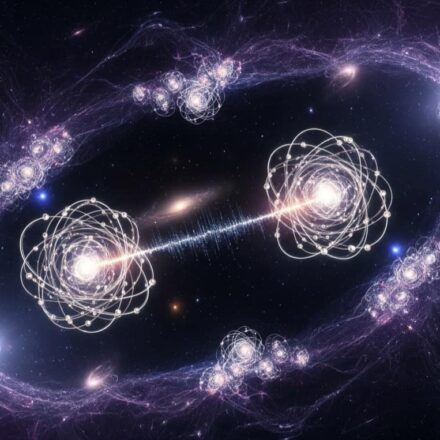




In 1935, Albert Einstein, vexed by the bizarre predictions of a new theory, derisively described a phenomenon as “spukhafte Fernwirkung”—spooky action at a distance. The idea was that two particles could become so deeply linked that they would act as a single entity, no matter how far apart they were separated. Measuring a property of one particle would instantaneously influence the other, even across galaxies. To Einstein, this violated the laws of physics as he knew them. It was a paradox, a ghost in the machine of quantum mechanics. Yet, nearly a century later, this “spooky action” is not only proven to be real, but it’s also poised to become the bedrock of revolutionary technologies that could redefine our world. So, is entanglement a mere cosmic curiosity or the key to our future?
Table Of Content
What is Quantum Entanglement? The Glove Analogy
Trying to visualize the quantum world is notoriously difficult, but a simple analogy can help us grasp the basics of entanglement.
Imagine you have a pair of gloves, one left and one right. Without looking, you place each glove into a separate, identical box. You keep one box and give the other to a friend who travels to the far side of the universe. At the moment you open your box and see a left-handed glove, you know, with absolute certainty and faster than any signal could ever travel, that your friend’s box contains the right-handed glove.
This seems straightforward, but quantum entanglement is even stranger. In the glove analogy, each glove was alwayseither left or right, even before you opened the box. In the quantum realm, the particles don’t have definite properties until they are measured. Imagine instead of gloves, you have two “spin” particles. Before you measure them, each particle is in a state of fuzzy potential, being both “spin up” and “spin down” at the same time—a concept called superposition.
Only when you measure one particle does it “choose” a state, say, “spin up.” And in that exact instant, its entangled twin, no matter the distance, immediately “chooses” the opposite state, “spin down.” The spookiness lies in this instantaneous correlation between two particles that had no predetermined state. It’s as if the universe enforces a connection between them that transcends space and time.
From “Spooky Action” to Nobel Prize-Winning Fact
For decades, many physicists sided with Einstein, believing entanglement was a sign that quantum theory was incomplete. They argued there must be hidden variables—like the “left-ness” or “right-ness” of the gloves—that we just couldn’t see. This debate, known as the Einstein-Podolsky-Rosen (EPR) paradox, simmered until the 1960s when Irish physicist John Stewart Bell devised a brilliant mathematical theorem. Bell’s theorem provided a way to experimentally test whether hidden variables existed or if the spooky connection was real.
Starting in the 1970s, a series of increasingly precise experiments were conducted to put Bell’s theorem to the test. Physicists John Clauser, Alain Aspect, and Anton Zeilinger each, in turn, closed loopholes in previous experiments, slammed the door on hidden variables, and proved that quantum entanglement is a fundamental and undeniable feature of our universe. Their groundbreaking work, spanning five decades, earned them the 2022 Nobel Prize in Physics, officially moving entanglement from a philosophical debate to a tool for building new technologies.
A surprising fact: While the connection between entangled particles is instantaneous, it cannot be used to send information faster than light. This is because you can’t control the outcome of your measurement. You might measure “spin up” or “spin down”—the result is random. Your friend on the other side of the universe will see an equally random result that is perfectly correlated with yours, but because neither of you can force a specific outcome, no actual message can be sent. The universe preserves causality.
The Future is Entangled: Quantum Technologies
Harnessing this spooky connection is at the heart of the next technological revolution. Here are a few ways it’s changing the game:
- Quantum Computing: A classical computer bit is a 0 or a 1. A quantum bit, or qubit, can be both 0 and 1 at the same time (superposition). By entangling qubits, you link their fates, creating an exponentially more powerful computational space. Two entangled qubits can represent four values at once (00, 01, 10, 11). Three can represent eight. With just 300 entangled qubits, a quantum computer could represent more values than there are atoms in the known universe, allowing it to solve complex problems in medicine, materials science, and cryptography that are impossible for even the most powerful supercomputers today.
- Unhackable Communication: Quantum entanglement offers the promise of perfectly secure communication. If two parties, Alice and Bob, share a stream of entangled particles, they can use them to generate a secret key for encrypting messages. If an eavesdropper, Eve, tries to intercept and measure a particle, the act of measurement will instantly break the entanglement. Alice and Bob will immediately know their channel has been compromised, making quantum communication inherently secure.
- Hyper-Sensitive Sensing: Entangled particles are incredibly sensitive to their environment. This property can be used to build quantum sensors of unprecedented precision. These sensors could detect minute gravitational waves, allow submarines to navigate without GPS by sensing tiny variations in Earth’s gravitational field, or lead to medical imaging (like MRIs) that can observe the functions of single cells.
Another little-known fact: Scientists have managed to entangle not just pairs of particles, but large clusters of thousands or even millions of atoms. They have even entangled macroscopic objects, like two tiny aluminum drums, pushing the boundaries of what we thought could exist in a quantum state.
Einstein’s “spooky action” has journeyed from a theoretical puzzle to the frontier of innovation. The very thing he saw as a flaw in quantum mechanics may prove to be its most powerful feature.
As we learn to weave these invisible, instantaneous connections into the fabric of our technology, we are forced to wonder: what other “spooky” secrets does the universe hold, and how will they reshape our world once we learn to harness them?
References:
- Einstein, A., Podolsky, B., & Rosen, N. (1935). Can Quantum-Mechanical Description of Physical Reality Be Considered Complete? Physical Review, 47(10), 777–780.
- Bell, J. S. (1964). On the Einstein Podolsky Rosen Paradox. Physics Physique Fizika, 1(3), 195–200.
- The Royal Swedish Academy of Sciences. (2022, October 4). The Nobel Prize in Physics 2022: Scientific Background. The Nobel Foundation.
- Aspect, A., Dalibard, J., & Roger, G. (1982). Experimental Test of Bell’s Inequalities Using Time-Varying Analyzers. Physical Review Letters, 49(25), 1804–1807.