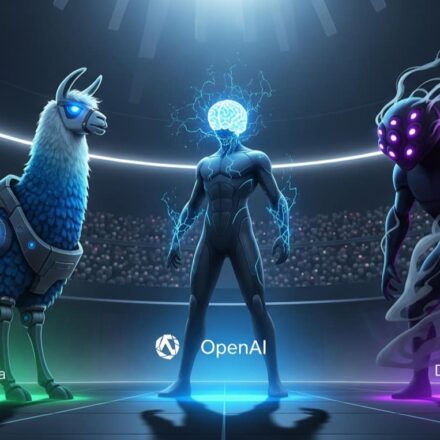





We stand at the edge of a new era, captivated and terrified by the machines we’ve built. The narrative is intoxicating: as we build larger and larger artificial intelligence models, they don’t just get smarter—they spontaneously awaken. Seemingly overnight, these Large Language Models (LLMs) develop “emergent abilities”—complex skills in reasoning, coding, and problem-solving that were utterly absent in their smaller predecessors. This idea has fueled a feverish excitement about a future of god-like superintelligence and a deep-seated dread of an uncontrollable power we are unleashing upon the world.
But what if the ghost in the machine is just a trick of the light? A groundbreaking and contentious debate is raging in the scientific community, asking a question that could redefine our entire understanding of AI: Are these miraculous leaps in intelligence real, or are they a sophisticated “mirage” created by the very yardsticks we use to measure them?
The Allure of the Unpredictable Leap
The concept of emergence is what makes modern AI feel so revolutionary and so dangerous. It’s the idea that at a certain scale, a system’s properties can change “seemingly instantaneously from not present to present”. One day a model can’t do basic math; the next, a slightly larger version can. This unpredictability is the central concern for AI safety. If we can’t foresee what dangerous capabilities a model might suddenly acquire, how can we possibly control it? This fear has shaped policy, driven research, and painted a picture of AI as a mysterious, almost magical force.
Pulling Back the Curtain: The Metric Mirage
A 2023 paper from a team of Stanford researchers, however, pulls back the curtain on this magic show, and what they reveal is shockingly simple. The “emergence,” they argue, isn’t a property of the AI at all. It’s an illusion—an artifact created by the metrics we choose.
Imagine you’re grading a math test. If you use a harsh, nonlinear metric like “Accuracy”—where a student gets zero points unless the entire multi-digit answer is perfect—you might see a student fail for months. Their underlying understanding might be improving steadily, making fewer and fewer small errors, but their score remains zero. Then, one day, they cross a critical threshold of competence and suddenly start getting answers completely right. From the perspective of your “Accuracy” metric, their ability emerged overnight.
This, the researchers argue, is exactly what’s happening with AI. When they re-analyzed the same models using continuous metrics—like “Token Edit Distance,” which gives partial credit by counting individual errors—the magic vanished. The sudden, sharp jump in ability was replaced by a smooth, predictable, and continuous line of improvement.The steady progress was there all along; our blunt instruments just couldn’t see it.
A New Kind of Danger?
This discovery has profound consequences. On one hand, it’s good news for AI safety. If model improvement is predictable, it becomes far easier to manage and control. But it also reveals a new, more subtle danger.
Even if the underlying progress is smooth, the functional outcome can still feel like a sudden leap. A system that cannot reliably perform a task is, for all practical purposes, qualitatively different from one that can. The real risk, then, may not be an AI that unpredictably goes rogue. The risk is a humanity that is “measurement-blind”—unable to perceive the steady, continuous growth of a dangerous capability until it crosses a critical, and potentially irreversible, functional threshold. We could be blindsided not by the AI’s sudden awakening, but by the limitations of our own perception.
The debate forces us to confront a new reality. The intelligence we are building may not be mysterious or magical at all, but a predictable product of scale. The true unknown is not what the machine will do, but whether we can learn to see it clearly before it’s too late.