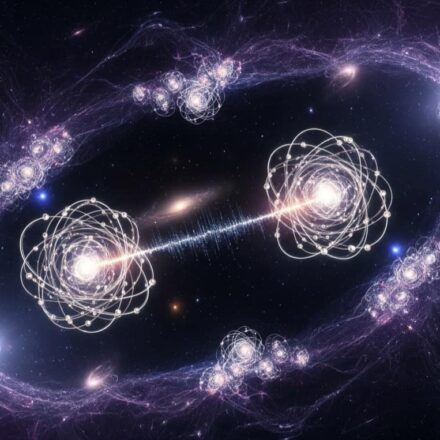




Look up at the night sky. The stars, planets, and shimmering galaxies you see are just the luminous tip of a colossal iceberg. Everything we can see—every atom in our bodies, our planet, and all the stars in the cosmos—makes up a mere 5% of the known universe. The rest is a profound mystery. About 27% is a ghostly, invisible substance known as dark matter, a cosmic glue holding galaxies together. For decades, it has been the biggest enigma in physics, an unseen presence whose gravity shapes the universe. But the era of blind searching is ending. Armed with ultra-sensitive detectors and radical new theories, scientists are closer than ever to finally unmasking this galactic ghost.
Table Of Content
The Galactic Ghost: Why We Know It Exists
We can’t see, touch, or taste dark matter, so how are we so sure it’s out there? The evidence is written in the movement of the stars. In the 1970s, astronomer Vera Rubin was studying the rotation of spiral galaxies and noticed something deeply strange. According to Newtonian physics, stars on the outer edges of a galaxy should move much slower than those near the dense, star-packed center—just as the outer planets in our solar system orbit the sun more slowly than the inner ones.
But Rubin found the opposite. The outer stars were moving just as fast as the inner ones. It was like watching a merry-go-round where the horses on the outer rim were spinning at the same blistering speed as the ones in the middle. The only way to explain this was if the galaxies were embedded in a massive, invisible halo of matter, providing the extra gravitational pull needed to keep these speedy stars from flying off into space.
Another key piece of evidence is gravitational lensing. According to Einstein’s theory of general relativity, massive objects bend the fabric of spacetime. When light from a distant galaxy passes through a region with a lot of mass, its path is bent, creating distorted, magnified, or even multiple images of the background galaxy. Scientists have observed light being bent by far more gravity than visible matter can account for. This cosmic mirage is the shadow of dark matter, revealing its presence through its powerful gravitational influence.
A surprising fact: Dark matter is not just the glue holding individual galaxies together; it’s the cosmic scaffolding for the entire universe. The vast, web-like structure of galaxy clusters and superclusters we see today grew from seeds of clumped dark matter in the early universe. The visible matter we see simply fell into these pre-existing gravitational wells.
The Hunt for a Phantom: Who Are the Suspects?
So, what is this stuff? For decades, the leading candidate has been a hypothetical particle called a WIMP (Weakly Interacting Massive Particle). WIMPs are thought to be heavy, slow-moving particles created in the Big Bang. As their name suggests, they interact with normal matter only through the weak nuclear force and gravity, meaning they can pass through solid objects (and you) as if they weren’t there.
The hunt for WIMPs involves building some of the quietest, most pristine detectors on Earth, located deep underground to shield them from cosmic rays. Experiments like LUX-ZEPLIN (LZ) in South Dakota and XENONnT in Italy consist of huge vats of liquid xenon. The hope is that, very rarely, a WIMP will fly through the detector and bump directly into a xenon nucleus, creating a tiny flash of light that sensitive detectors can pick up.
But after years of searching with ever-larger detectors, WIMPs have failed to show up. This has fueled excitement for another, very different suspect: the axion. Axions are hypothesized to be ultralight particles, potentially billions of times less massive than an electron. They are the polar opposite of WIMPs—tiny and incredibly numerous. Experiments like the Axion Dark Matter eXperiment (ADMX) at the University of Washington use a different strategy. They employ powerful magnetic fields inside a resonant cavity, trying to coax the axions to convert into tiny, detectable flashes of light (photons).
Another surprising fact: As you read this, you are flying through a constant “wind” of dark matter. Our solar system is orbiting the center of the Milky Way at about 230 kilometers per second, moving through the galaxy’s vast dark matter halo. Scientists calculate that billions of dark matter particles are likely passing through your body every second, completely unnoticed.
Closing In: Breakthroughs on the Horizon
While a definitive discovery remains elusive, the feeling in the physics community is one of growing excitement, not disappointment. The WIMP experiments, by finding nothing, have successfully ruled out huge ranges of possible properties, dramatically narrowing the search. As LZ spokesperson Kevin Lesko noted, these results are “ruling out a huge swath of theoretical models,” allowing scientists to focus their efforts.
Simultaneously, the hunt for axions and other exotic particles is rapidly accelerating. New experiments using cutting-edge quantum sensors are being designed to look for the subtle oscillations that a sea of axions might produce. We are no longer just looking for one type of particle in one way. The search has diversified into a multi-front campaign, attacking the mystery from every conceivable angle.
A final surprising fact: The name “dark matter” is a bit of a misnomer. A better term might be “transparent matter.” It isn’t dark in the way a shadow is, by blocking light. It’s dark because it is completely indifferent to light. Photons, the particles of light, pass right through it as if it’s not there at all.
We stand at a unique moment in the history of science. The ghost in the universe has been cornered. The clues are all around us, and the traps are set. Finding the dark matter particle would be more than just solving a cosmic accounting problem; it would open a portal to a hidden sector of physics and reveal a new, fundamental piece of reality.
If we finally meet the ghost that has shaped our universe since the dawn of time, how will it change our understanding of our place within it?
References
- NASA Science. (n.d.). Dark Energy, Dark Matter.
- LUX-ZEPLIN (LZ) Experiment. (n.d.). The LZ Dark Matter Experiment. Official Website.
- Link: https://lz.lbl.gov/
- Axion Dark Matter eXperiment (ADMX). (n.d.). ADMX. Official Website.
- Bertone, G., & Hooper, D. (2018). History of dark matter. Reviews of Modern Physics, 90(4), 045002.
- Rubin, V. C., Ford, W. K., & Thonnard, N. (1980). Rotational properties of 21 Sc galaxies with a large range of luminosities and radii, from NGC 4605 (R=4kpc) to UGC 2885 (R=122kpc). The Astrophysical Journal, 238, 471-487.
- Note: A seminal paper by Vera Rubin outlining the observations that provided key evidence for dark matter.
- Link: https://adsabs.harvard.edu/full/1980ApJ…238..471R