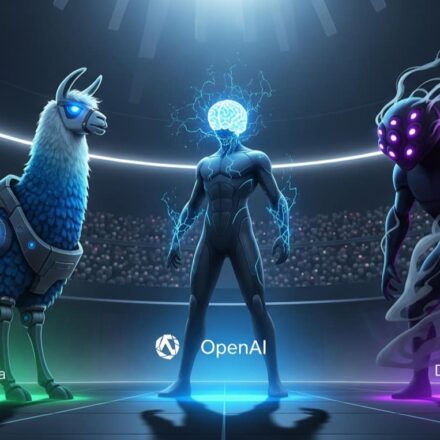





In the world of technology, there are races, and then there is the race for Artificial General Intelligence (AGI). It’s a theoretical finish line where an AI system becomes so autonomous it can perform a human’s job, a goal that has ignited a global spending frenzy and a battle for technological dominance. When OpenAI CEO Sam Altman described his company’s latest model as a “significant step forward but not a leap over the finish line,” he perfectly captured the current moment: a high-stakes, high-investment sprint into a future that remains scientifically uncertain.
Table Of Content
The world’s largest tech companies, from OpenAI and Google to Meta and Anthropic, are pouring hundreds of billions of dollars into this quest. Yet, behind the bold pronouncements and record-breaking valuations lies a fascinating, and at times confounding, reality. The race to AGI is being run on a track where the finish line keeps moving, the rulebook is still being written, and success, as one analyst puts it, feels distinctly “vibes-based.”
Defining the Finish Line: What Exactly is AGI?
The very definition of AGI is a source of intense debate and a “moving target,” according to Matt Murphy, a partner at VC firm Menlo Ventures. OpenAI defines it as a system capable of outperforming humans at most economically valuable work. For Mark Zuckerberg, the goal is “superintelligence”—an AI that far exceeds human cognitive abilities.
This ambiguity makes the race uniquely challenging. As tech analyst Benedict Evans colorfully describes it, the quest for AGI is like “building the Apollo programme but we don’t actually know how gravity works or how far away the moon is.” He argues that without a solid theoretical model explaining why current generative AI models work so well, the path to AGI is based more on intuition and “personal vibes” than on a clear scientific roadmap. This sentiment is echoed by many sensible experts who acknowledge the impressive progress but caution that the foundational understanding is still incomplete.
Despite this uncertainty, some are placing bets on a more concrete timeline. Aaron Rosenberg of Radical Ventures offers a narrower, more pragmatic definition: achieving at least 80th percentile human-level performance in 80% of economically relevant digital tasks. By this metric, he believes AGI could be within reach within the next five years.
The Fuel for the Race: Unprecedented Financial Investment
Regardless of the scientific uncertainty, the financial commitment is staggering. According to a Wall Street Journal report, Google’s parent Alphabet, Meta, Microsoft, and Amazon are set to spend nearly $400 billion on AI this year alone—an amount that comfortably surpasses the combined defence spending of the European Union.
This investment is paying dividends, even without achieving full AGI. OpenAI’s annual recurring revenue has reportedly skyrocketed to $13 billion, with projections suggesting it could pass $20 billion by the end of the year. The company is also in talks for a share sale that could value it at an astronomical $500 billion, placing it in the same league as Elon Musk’s SpaceX. This immense commercial success ensures that the generative AI systems we use today will continue to become more powerful, funded by their own incredible profitability.
However, some experts warn that the relentless focus on “superintelligence” serves more as competitive positioning than a reflection of actual breakthroughs. David Bader, director of the institute for data science at the New Jersey Institute of Technology, suggests it distracts from more immediate concerns, such as ensuring current systems are reliable, transparent, and free of bias.
A Global Contest: The US vs. China
The race for AGI is not just a competition between Silicon Valley giants; it is a global contest with significant geopolitical implications, primarily between the US and China. While US firms like Google, OpenAI, and Anthropic often dominate the headlines, Chinese companies are making formidable advances.
According to Artificial Analysis, which ranks AI models on metrics like intelligence and speed, six of the top 20 models on its leaderboard are now Chinese, developed by firms like DeepSeek, Zhipu AI, Alibaba, and MiniMax. In the rapidly evolving field of video generation, Chinese models hold six of the top ten spots.
DeepSeek, a relative newcomer, has already launched a model with reasoning abilities comparable to OpenAI’s best work. Its technology is being integrated by major global companies like Saudi Aramco, which reports that DeepSeek’s AI is “really making a big difference” in its operational efficiency.
This global adoption is the key battleground. As Microsoft’s president, Brad Smith, stated in a US Senate hearing, the ultimate winner of the AI race will be determined by “whose technology is most broadly adopted in the rest of the world.” The lesson from the 5G race, where Huawei established a dominant market position, looms large. The ability to be supplanted once leadership is established is incredibly difficult.
The Path Forward: An Inevitable, Uncertain Sprint
Five years ago, suggesting AGI was on the horizon was almost heresy. Today, the consensus is shifting rapidly. The relentless pace of innovation, fueled by immense capital and global competition, has made the path toward AGI feel inevitable, even if its final form and arrival date remain unknown.
The innovation cycle is breathtakingly fast. As soon as one company makes a breakthrough, others are quick to adopt and replicate it, making it difficult for any single player to maintain a significant lead for long. This ensures a continuous, high-speed sprint. While arguments over the feasibility of superintelligence will continue, one thing is certain: the world’s two largest economies and their most powerful technology firms are fully committed to running this race, pouring vast resources and talent into crossing a finish line they are all defining as they go.