


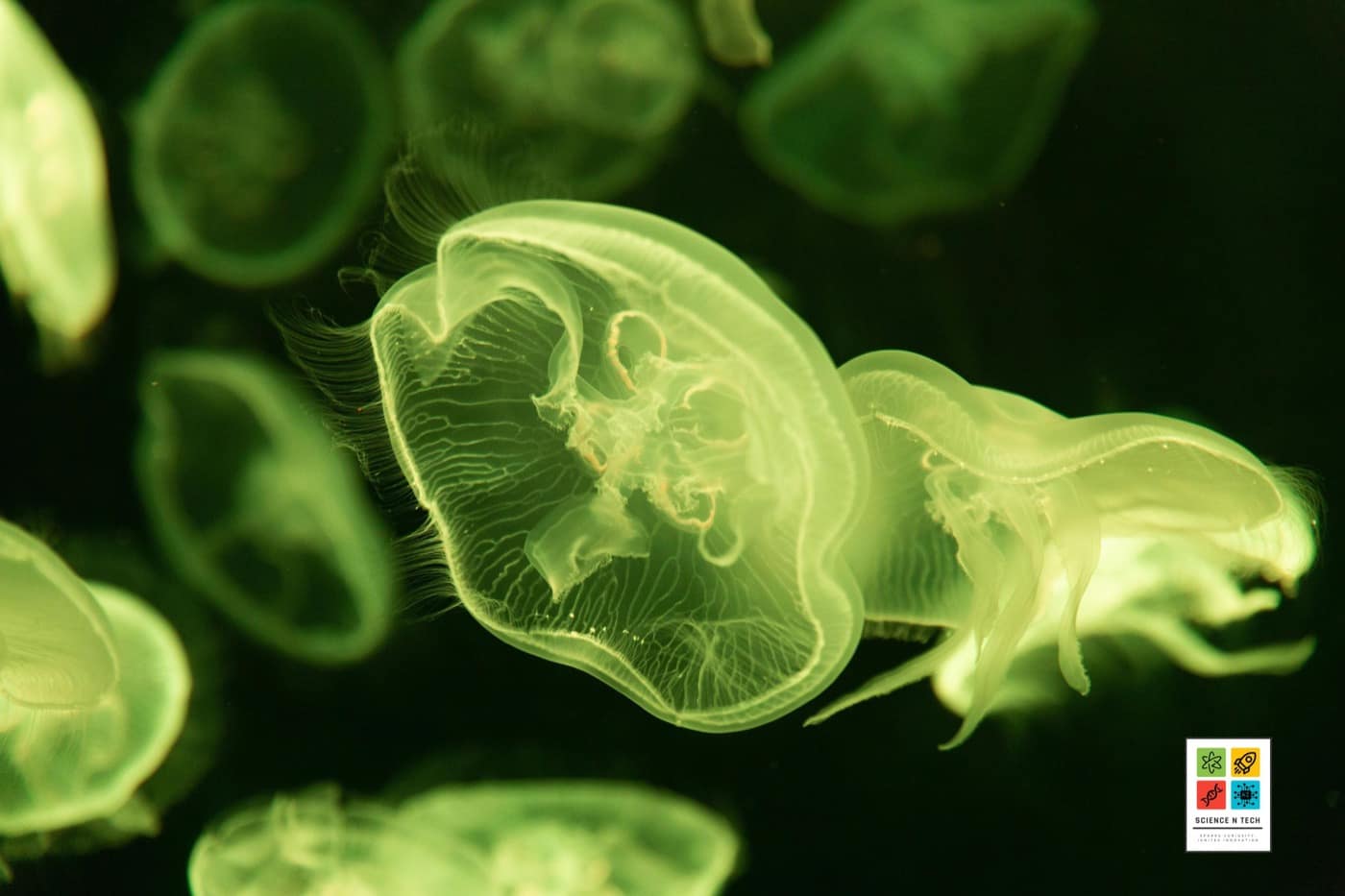

Plunge into the deep ocean, a realm of crushing pressure and eternal night where sunlight has never reached. You might expect absolute blackness, but suddenly, the void is shattered by a silent, ghostly explosion of light. A chain of ethereal blue jellyfish pulses past, a fish dangles a luminous lure, and a squid vanishes in a cloud of glowing ink. This is not magic; it is bioluminescence, nature’s own neon light show. And this secret world of living light isn’t just confined to the abyss. It illuminates our forests, our caves, and even the waves breaking on our shores. What is the chemistry behind this “cold light,” and what secrets does it reveal about life’s incredible ingenuity?
Table Of Content
The Chemistry of Cold Light: How Bioluminescence Works
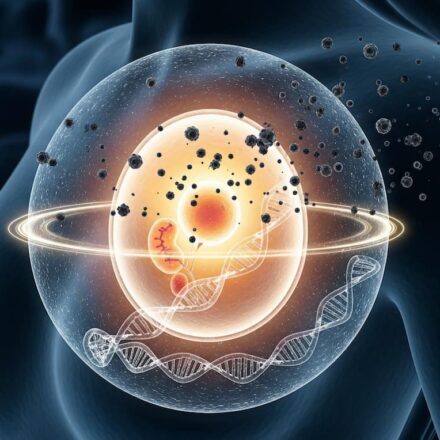
At its heart, bioluminescence is a simple, elegant chemical reaction. It typically involves two key ingredients: a light-producing molecule called luciferin (from the Latin lucifer, “light-bringer”) and an enzyme called luciferase. When luciferase acts on luciferin in the presence of oxygen, it triggers a reaction that releases energy in the form of a photon—a particle of light.
What makes this process so remarkable is its incredible efficiency. Unlike a light bulb, which wastes most of its energy as heat, bioluminescence is a “cold light.” Some reactions can convert up to 98% of their energy directly into light, making it one of the most efficient light sources on the planet.
Even more fascinating is that life didn’t just invent this trick once. Scientists have found that bioluminescence has evolved independently at least 40 to 50 different times across the tree of life. While the principle is the same, the specific type of luciferin can be completely different between a firefly, a fungus, and a deep-sea fish. It’s a stunning example of convergent evolution, where nature has repeatedly arrived at the same brilliant solution to surviving in the dark.
A Symphony of Signals: The Many Languages of Light
Living light is a language, used for every aspect of survival in the wild. Creatures have evolved to use it for a dazzling array of purposes.
- To Attract: The most famous examples are for mating and luring prey. Male fireflies produce specific flashing patterns to signal their species and fitness to females. In the crushing dark of the bathyal zone, the deep-sea anglerfish uses a fleshy, glowing lure dangling from its head to entice smaller fish directly into its waiting jaws.
- To Defend: Light can be a powerful defensive weapon. When threatened, the vampire squid ejects a sticky cloud of glowing mucus instead of ink. This luminous smokescreen blinds and confuses predators, allowing the squid to escape into the darkness. Many species of shrimp and krill use a “burglar alarm” tactic—flashing brightly to attract a bigger predator that will go after their attacker.
- To Camouflage: Perhaps the most ingenious use of light is for camouflage. The hatchetfish, which lives in the ocean’s twilight zone, has rows of light-producing organs called photophores on its belly. It uses these to perfectly match the faint sunlight filtering down from above, a technique called counter-illumination. This erases its silhouette, making it effectively invisible to any predators lurking below.
A surprising fact: Some creatures don’t even make their own light; they “steal” it through symbiosis. The small Hawaiian bobtail squid cultivates a specific species of glowing bacteria, Vibrio fischeri, in a special light organ. The squid houses and feeds the bacteria, and in return, the bacteria provide the perfect light source for the squid’s counter-illumination camouflage, which it can turn on and off by controlling the oxygen supply to the bacteria.
Beyond the Deep: Unexpected Glows on Land and Sea
While the deep ocean is home to the most bioluminescent species, this phenomenon can be found in many other environments.
- Foxfire: In damp, decaying forests around the world, certain species of fungi, like the Honey Mushroom, create an eerie, sustained glow known as “foxfire.” Scientists believe this glow may attract nocturnal insects that then help to spread the fungus’s spores.
- Milky Seas: Sailors have long told tales of sailing through vast, eerie stretches of ocean that glow with a uniform, milky white light. This spectacular phenomenon, visible from space, is caused by trillions of bioluminescent bacteria communicating and glowing in unison. On a smaller scale, anyone who has seen waves crash with a blue sparkle has witnessed the protest flashes of billions of dinoflagellates (plankton) being disturbed.
- Glowworm Caves: In the famous caves of Waitomo, New Zealand, the ceilings are adorned with what looks like a starry night sky. These “stars” are actually the larvae of a fungus gnat, Arachnocampa luminosa. They produce a soft blue-green light to lure prey into their dangling, sticky fishing lines of silk.
Another little-known fact: The most common color for bioluminescence is blue-green. This is no accident. Blue light travels the farthest through water, making it the most effective wavelength for long-distance communication and vision in the marine environment, where the vast majority of glowing creatures reside.
As marine biologist and deep-sea explorer Dr. Edith Widder puts it, “Bioluminescence is the language of light in the deep ocean.” It’s a language we are only just beginning to understand.
Bioluminescence gives us a tantalizing glimpse into a world that communicates in a vocabulary of light. With over 80% of our oceans still unexplored, what other luminous creatures and secret signals are waiting to be discovered in the darkness below, and what can they teach us about the boundless creativity of life?
References
- Widder, E. A. (2010). Bioluminescence in the Ocean: Origins of Biological, Chemical, and Ecological Diversity. Science, 328(5979), 704-708.
- National Oceanic and Atmospheric Administration (NOAA). (n.d.). What is bioluminescence?
- Ocean Research & Conservation Association (ORCA). (n.d.). Bioluminescence.
- Note: Founded by Dr. Edith Widder, ORCA is a key resource for bioluminescence research.
- Link: https://www.teamorca.org/cfiles/bioluminescence.cfm
- National Geographic. (n.d.). Bioluminescence. Resource Library.
- Haddock, S. H. D., Moline, M. A., & Case, J. F. (2010). Bioluminescence in the Sea. Annual Review of Marine Science, 2, 443-493.