


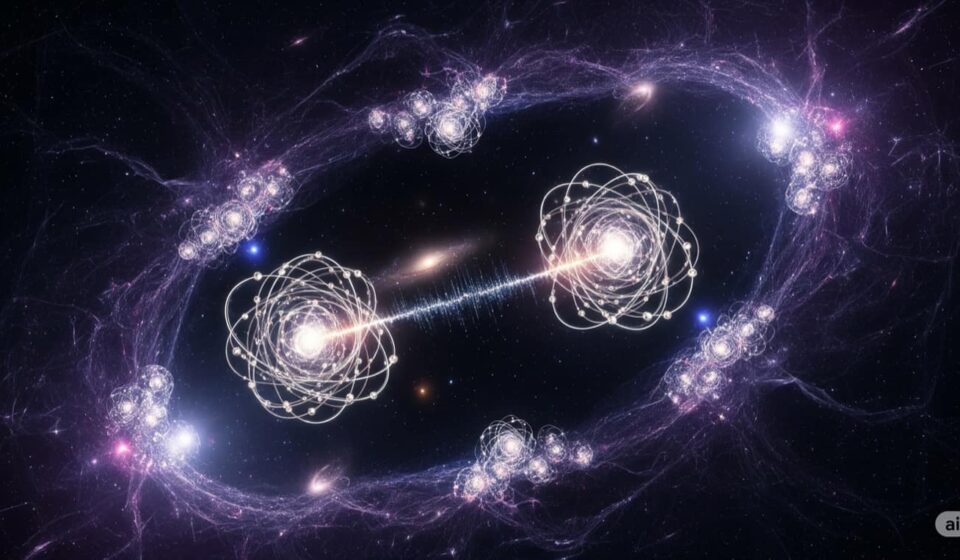

Our reality is built on four fundamental pillars: the four known forces of nature. Gravity holds planets in orbit, electromagnetism powers our technology, and the strong and weak nuclear forces govern the atomic world. For decades, this quartet has formed the basis of the Standard Model of particle physics, our best explanation for the universe’s building blocks. But what if there’s a hidden side to the cosmos, a fifth force operating in the shadows?
Table Of Content
This tantalizing possibility is at the heart of a wave of new, ultra-precise experiments that could finally unlock one of science’s most profound mysteries: the nature of dark matter.
The Dark Matter Enigma
For all its success, the Standard Model is incomplete. It beautifully describes the particles and forces we can see and measure, but that only accounts for about 5% of the universe. The other 95% is composed of dark matter and dark energy. Dark matter is the invisible “scaffolding” of the cosmos; its gravitational pull is the reason galaxies don’t fly apart and why they’re organized in the vast cosmic web we observe.
We know dark matter is there because we can see its gravitational effects, but we don’t know what it is. It doesn’t interact with light or any other form of electromagnetic radiation, making it completely invisible to our instruments. This is where the search for a fifth force becomes so critical. Such a force could be the bridge connecting the world we know with the dark, unseen universe.
Listening for Atomic Whispers at ETH Zurich
In a groundbreaking study from ETH Zurich, physicists have taken a novel approach to hunt for this elusive force. Instead of smashing particles together in massive colliders, they are listening for the faintest of “whispers” from individual atoms. Their research, published in the prestigious journal Physical Review Letters, details a series of experiments that have pushed the boundaries of precision measurement.
The international team, involving researchers from Switzerland, Germany, and Australia, focused on calcium atoms. The core idea is that if a new force exists that acts between an atom’s electrons and the neutrons in its nucleus, its strength should depend on the number of neutrons. Different versions of an element, called isotopes, have the same number of protons but varying numbers of neutrons. Therefore, this hypothetical fifth force should cause tiny, but measurable, shifts in the energy levels of different calcium isotopes.
To detect these minuscule shifts, the scientists used a technique called precision atomic spectroscopy. They trapped five different stable isotopes of calcium (all with 20 protons, but with neutron counts from 20 to 28) in an electromagnetic field. By probing these trapped atoms with lasers, they could measure the frequency of light emitted when an electron jumped between energy levels with an accuracy of 100 millihertz—a precision one hundred times greater than any previous attempt.
The Verdict from the “King Plot”
The key to interpreting these results lies in something called a King plot. In simple terms, a King plot compares the energy shifts between different pairs of isotopes. According to the Standard Model, the data points on this plot should form a perfectly straight line. Any deviation from this line—a “nonlinearity”—could be a sign of new physics, like a fifth force.
For the first time ever, the team’s incredibly precise measurements revealed a distinct nonlinearity in the calcium King plot. However, this isn’t a “eureka” moment just yet. The physicists had to rule out other complex effects within the Standard Model that could also cause such a deviation. Their calculations showed that a little-studied phenomenon known as nuclear polarization—a slight deformation of the atomic nucleus by its electrons—could potentially explain the nonlinearity they observed.
As research leader Aude Craik from ETH Zurich cautiously stated, “We can’t say that we’ve discovered new physics here.”
Narrowing the Search and Charting the Future
While the experiment didn’t definitively find a fifth force, it achieved something equally important: it dramatically narrowed the search. The results have allowed physicists to place the tightest constraints ever on the possible strength of such a force and the mass of the particle that might carry it. They have effectively mapped the terrain, showing future experiments where not to look, and focusing the search on more promising territory.
The quest is far from over. The team is already working to improve its measurements by adding a third dimension to their King plot, which they hope will help untangle the known nuclear effects from any potential new physics.
If this fifth force is confirmed, it would be nothing short of a revolution. It would not only provide a candidate for the elusive dark matter particle but would fundamentally rewrite our understanding of the cosmos. The search continues, listening for a whisper that could change everything we know about reality.