


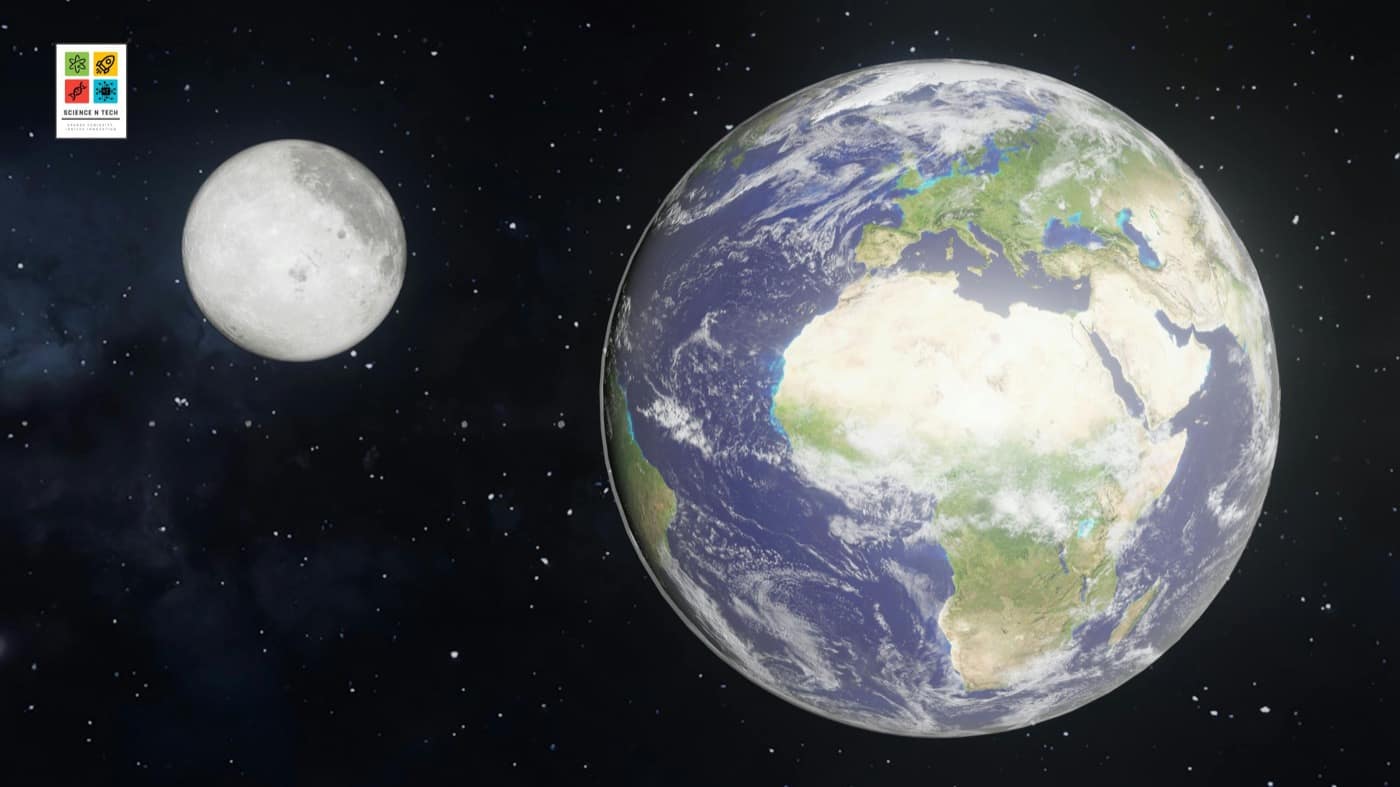

For as long as we have looked to the sky, the Moon has been our silent, steady companion. It’s a source of myth, a beacon for navigation, and a symbol of cosmic tranquility. The leading scientific story of its origin, however, is anything but tranquil. For decades, we’ve believed the Moon was born from a violent, planetary smash-up. But what if that wasn’t the whole story? What if the evidence for this cosmic crime scene has been hiding not in the sky, but deep beneath our feet all along?
Table Of Content
New research is turning our understanding of this ancient cataclysm on its head, revealing a story far stranger and more complex than we ever imagined—a story that suggests the ghost of another world may still be buried within our own.
The Crime Scene: Our Primordial Planet
The classic account of the Moon’s birth is the Giant-Impact Hypothesis, a theory with all the drama of a Hollywood blockbuster. The story goes like this: about 4.5 billion years ago, the early Earth was a molten, chaotic world. At the same time, another protoplanet—a Mars-sized object astronomers have nicknamed Theia—was on a collision course.1 ☄️
The resulting impact was an event of unimaginable scale. Theia struck the young Earth, not head-on, but with a glancing blow that vaporized both the intruder and a huge portion of our planet’s crust and mantle. This incandescent cloud of molten rock and gas was blasted into orbit, where gravity slowly worked its magic. Over thousands of years, this debris coalesced, cooled, and solidified to form the Moon.
This theory elegantly explained many long-standing mysteries:
- Why the Moon is so large relative to Earth.
- Why its core is so small (most of the dense iron from both planets remained with Earth).
- Why lunar rocks brought back by the Apollo missions were made of similar material to Earth’s mantle but lacked volatile elements, which would have boiled off in the impact’s intense heat.
For a long time, the Giant-Impact Hypothesis was the perfect story. But as our tools became more precise, a shocking clue emerged that threatened to unravel the entire case.
The Twist: A Case of Mistaken Identity
The big problem came from isotopic fingerprints. Every object in the solar system has a unique chemical signature, a specific ratio of elemental isotopes, like a planetary DNA. If the Moon was formed from both Earth and a separate world, Theia, it should have a hybrid fingerprint—a mix of Earth and this foreign object.
But it doesn’t. When scientists analyzed the Apollo lunar samples with modern precision, they made a stunning discovery: the Moon and Earth are isotopically identical.2 They are so alike, it’s as if the Moon was cloned directly from our planet.
This finding threw planetary science into a crisis. How could the Moon be made only of Earth material if it was created by a collision with another planet? For the classic Giant-Impact theory to hold, Theia would have had to be made of the exact same material as Earth, a coincidence so unlikely it’s considered almost impossible. The perfect story had a giant hole in it.
The Buried Clue: A Ghost in Earth’s Mantle
This is where the story takes a turn from astronomy to geology, from the sky above to the ground below. For decades, seismologists have known about two massive, continent-sized blobs of unusually dense material lurking deep within Earth’s mantle, one beneath Africa and one beneath the Pacific Ocean.3 Known as Large Low-Shear-Velocity Provinces (LLSVPs), their origin was a complete mystery.
In a groundbreaking 2023 study published in Nature, scientists at the California Institute of Technology proposed a mind-bending new theory: these blobs are the buried remains of Theia.
Their simulations show that after the giant impact, Theia’s denser, iron-rich mantle didn’t just mix with Earth’s.4Instead, it sank through our planet’s molten interior, eventually settling on top of the core like geological ghosts. This is one of the most surprising recent discoveries in planetary science—the idea that the alien world that created our Moon isn’t gone, but has been a fundamental part of Earth’s deep interior for billions of years.
This not only provides a physical remnant of Theia but also helps explain some of Earth’s own mysterious geology, like the location of certain volcanic hotspots.
Rewriting the Story: Meet the Synestia
The discovery of Theia’s potential remains deepens the mystery and adds weight to a newer, even more violent version of the Moon’s birth: the Synestia model.
Proposed by planetary scientists Sarah Stewart and Simon Lock, this theory suggests the initial impact was so energetic it didn’t just create a ring of debris. It completely vaporized a large portion of both Earth and Theia, creating a single, massive, rapidly spinning donut of molten rock and gas called a synestia.
Imagine a celestial object shaped like a giant, puffy red blood cell, spinning furiously. The Earth wasn’t a solid planet at its center, but a molten core surrounded by this vast, unified cloud. Within this cloud, which was thousands of degrees, the material from Earth and Theia mixed perfectly, explaining the identical isotopic fingerprints.
As this structure gradually cooled over centuries, the Moon condensed from the vapor in the outer regions, while the Earth formed in the center. It’s a far more chaotic and extreme vision of creation, but it brilliantly solves the isotopic crisis.
An Unfinished Story Written in Starlight
The Moon we see tonight is not just a silent observer. It’s a survivor. It stabilizes our planet’s wobble, giving us the predictable seasons that allowed life to flourish.5 Without it, our days would be only 6-8 hours long, and our climate would be wildly unstable.
The story of its creation is a powerful reminder that science is not a set of facts, but a constantly evolving detective story. We’ve gone from a simple collision to a tale of mistaken identity, buried alien remnants, and a planet-sized donut of fire. The truth is still being uncovered, one lunar rock and seismic wave at a time.
So the next time you look up at the Moon, don’t just see a cratered rock. See a monument to the cosmic catastrophe that made our world possible. And then ask yourself: are you also feeling the faint gravitational pull of another world, buried just beneath your feet?